UPDATE RULE PLUGINS
replacement
Update rule plugin, entirely replacing the previous state with new information.
See also: https://creatingintelligence.org/#update-rules
Details
- Default plugin for
auto,delay, andtemporalcomponents. - Bypasses the component’s
capacitysetting. - Transparently handles multisets and inhibitory signals.
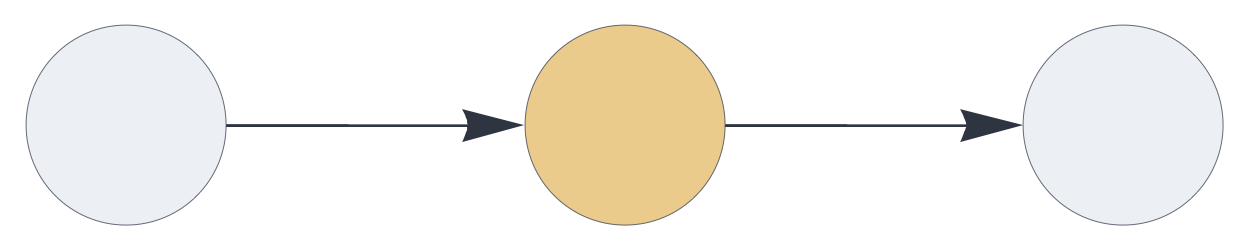
Stateless delay
The replacement update mechanism is the default
behavior of the delay
component.
{ "hyperparameters": {"default": [1000, 10]},
  "dataflow": [
    {"component": "input", "send": [1]},
    {"component": "delay", "send": [11], "receive": [1]},
    {"component": "output", "receive": [11]}
  ]}
Auto-associative memory with replacement update
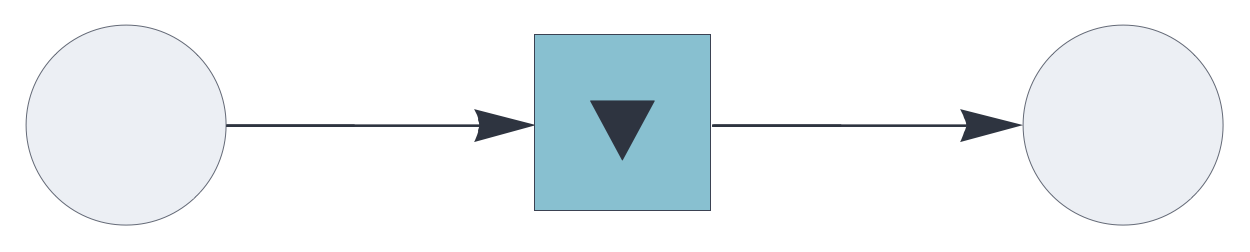
As the default update rule for the auto component,
replacement substitutes the memory’s state with the
retrieved value.
This is the classic auto-associative setup, most useful for pattern completion, denoising, and item stores. With this configuration, the auto-associative memory converges to a stable state. Stability is normally reached with just a single cycle because denoising iterations are already encapsulated within the memory retrieval algorithm.
{ "hyperparameters": {"default": [1000, 10]},
  "dataflow": [
    {"component": "input", "send": [1]},
    {"component": "auto", "send": [2], "receive": [1]},
    {"component": "output", "receive": [2]}
  ]}
See also: https://creatingintelligence.org/#auto-associative-memory
Temporal associative memory with replacement update
The temporal
component applies the replacement update rule by
default. At every execution cycle, it replaces the internal
state with the current input, bypassing the
capacity setting. This mechanism directly
associates each signal to the subsequent signal.
{ "hyperparameters": {"default": [1000, 10]},
  "dataflow": [
    {"component": "input", "send": [1]},
    {"component": "temporal", "send": [11], "receive": [1]},
    {"component": "output", "receive": [11]}
  ]}