CIRCUIT CONFIGURATION
Circuits
Within this framework, circuits represent networks of Topological Associative Memory instances encapsulated in circuit components and connected through pathways.
See also: https://creatingintelligence.org/#circuits
Circuit configuration
Circuits are specified by a JSON string or the equivalent Python dictionary:
{  "$schema": "https://creatingintelligence.org/schemas/circuit-v1.json",
   "options": {"name": "Reservoir"},
  "hyperparameters": {"default": [2000, 8], "61": [2000, 8]},
  "dataflow": [
    {"component": "input", "plugin": "codec", "send": [11]},
    {"component": "delay", "send": [21], "receive": [11]},
    {"component": "heteroencoder", "send": [51], "receive": [11, 21]},
    {"component": "delay", "send": [61],
            "receive": [[51, {"slot": 62, "tags": ["permute"]}]]},
    {"component": "delay", "send": [62],
            "receive": [61], "rate_limit": 3.0},
    {"component": "predictor", "send": [101], "receive": [11, [11, 61]]},
    {"component": "output", "plugin": "codec", "receive": [101]}
  ]}
The above configuration rendered as circuit schematics:
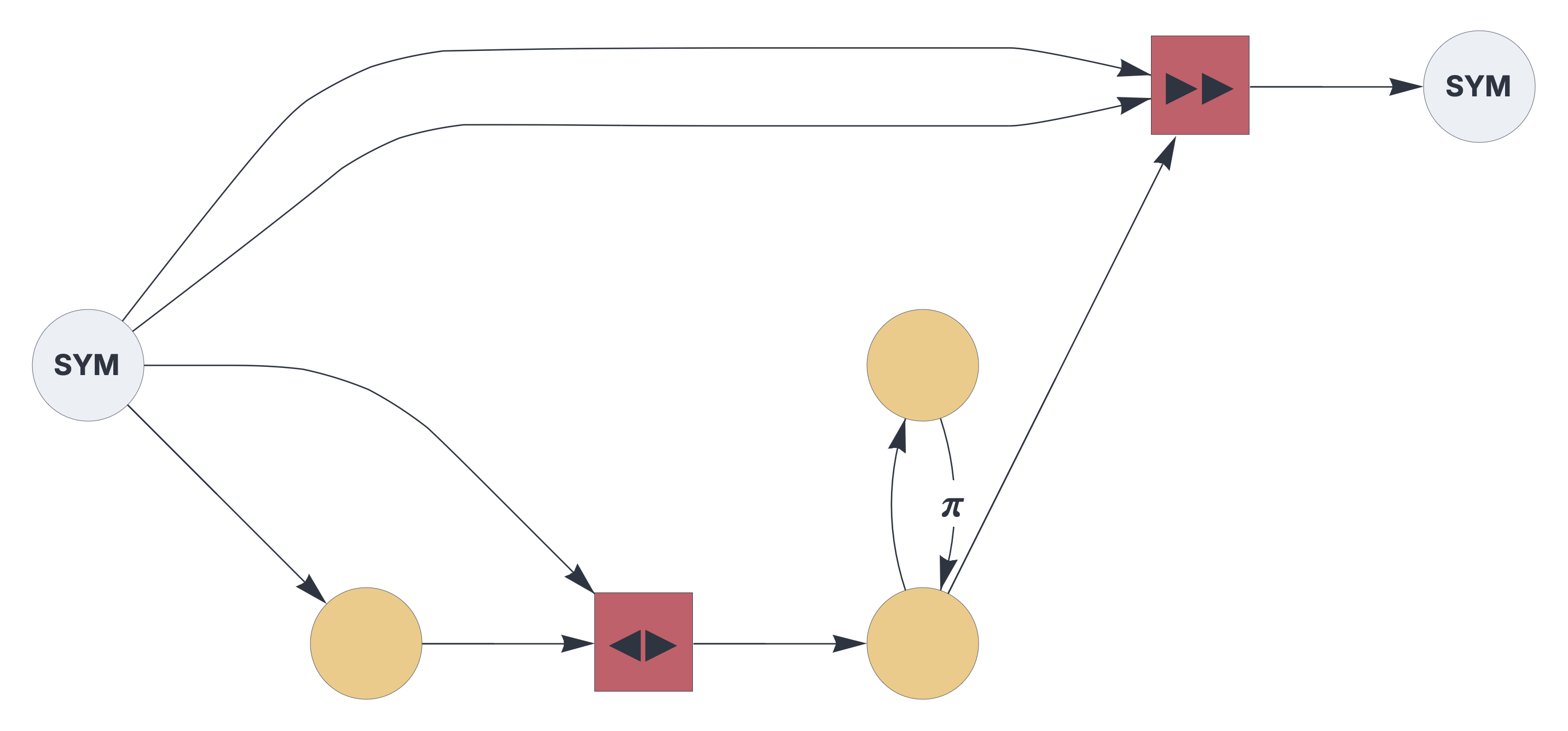
Details and properties
- Circuits are composed of stateful components connected through stateless pathways.
- Dataflow is synchronized, governed by a global clock.
- A latched circuit advances its clock only on cycles with input (see Latched circuits).
- At every time step, components process their current input and pass it into the output buffer.
- A circuit must include at least one input and one output component.
- Circuits can be nested.
| Property | Description |
|---|---|
$schema |
link to JSON schema |
options |
global circuit options |
hyperparameters |
pathway dimensions and populations |
dataflow |
nodes and edges of the circuit graph |
options
| Property | Description |
|---|---|
name |
the circuit’s registry identifier, used for embedding circuits |
multiplex |
temporal gating pattern, given as a list of 0s or 1s (optional) |
latch |
skip cycles in which all inputs are empty (optional, default false) |
hyperparameters
| Property | Description |
|---|---|
default |
default slot dimension and population [N, P] |
integer |
a specific slot’s dimension and population [N, P] |
dataflow
| Property | Description |
|---|---|
component |
the component’s factory function name |
plugin |
plugin factory function name (optional) |
send |
output slots, given as a list of integers |
receive |
list of input slots or tagged pathways |
Latched circuits
With the latch option, a circuit skips every
cycle in which all of its input blocks are empty (after input
encoding). Nothing is evaluated, the output blocks are empty,
and the circuit’s clock does not advance: delays, pathway gating
and the multiplex sequence only progress on cycles
with input. Inside a latched circuit, a sparse input stream
therefore has no gaps.
The option applies equally to a main circuit and to an embedded circuit, where the embedded
circuit’s own options decide.
Code
from creating_intelligence import Circuit

config = {
    "options": {"latch": True},
    "hyperparameters": {"default": [1000, 10]},
    "dataflow": [
        {"component": "input", "plugin": "codec", "send": [1]},
        {"component": "delay", "send": [2], "receive": [1]},
        {"component": "delay", "send": [3], "receive": [2]},
        {"component": "output", "plugin": "codec", "receive": [2]},
        {"component": "output", "plugin": "codec", "receive": [3]}
    ]
}
circ = Circuit(config)
for token in ["a", [], "b", [], [], "c", "d"]:
    print(circ["function"](token))
Output
('a', None)
(None, None)
('b', 'a')
(None, None)
(None, None)
('c', 'b')
('d', 'c')
The second output always holds the previous token, regardless
of the gaps between tokens. Without latch, the gaps
travel down the delay chain:
('a', None)
(None, 'a')
('b', None)
(None, 'b')
(None, None)
('c', None)
('d', 'c')
A latched circuit cannot run on internal feedback alone: a circuit that generates output from empty input (for example, a recurrent loop driven by its own feedback) must not be latched.