CIRCUIT COMPONENTS
associator

Hetero-associative memory component for supervised learning or state transition memories.
See also: https://creatingintelligence.org/#hetero-associative-memory
Details and properties
- Wrapper for a hetero-associative topological memory instance.
- Stores heteroassociations A -> B, where A can consist of multiple blocks
- Can represent a state transition memory {S,context} -> S’.
- Receives B from its first
receiveblock and A from the remaining blocks. - Learning is triggered if the label input is non-empty.
- Returns the retrieved set.
- Resolves multiset and inhibitory input prior to processing.
| Property | Default | Description |
|---|---|---|
send |
required | integer, representing a single output slot |
receive |
required | two or more input slots with pathway tags |
threshold |
automatic | relative pattern matching threshold |
residual |
unlimited | non-matching query elements that may be absorbed as noise, relative to the input population; 0 requires a full match |
rate_limit |
unlimited | subsample A if it exceeds the specified relative rate limit |
decimate |
1 | proportional stochastic decimation applied to A |
Use standard style options to customize the component’s appearance in circuit schematics.
Supervised learning
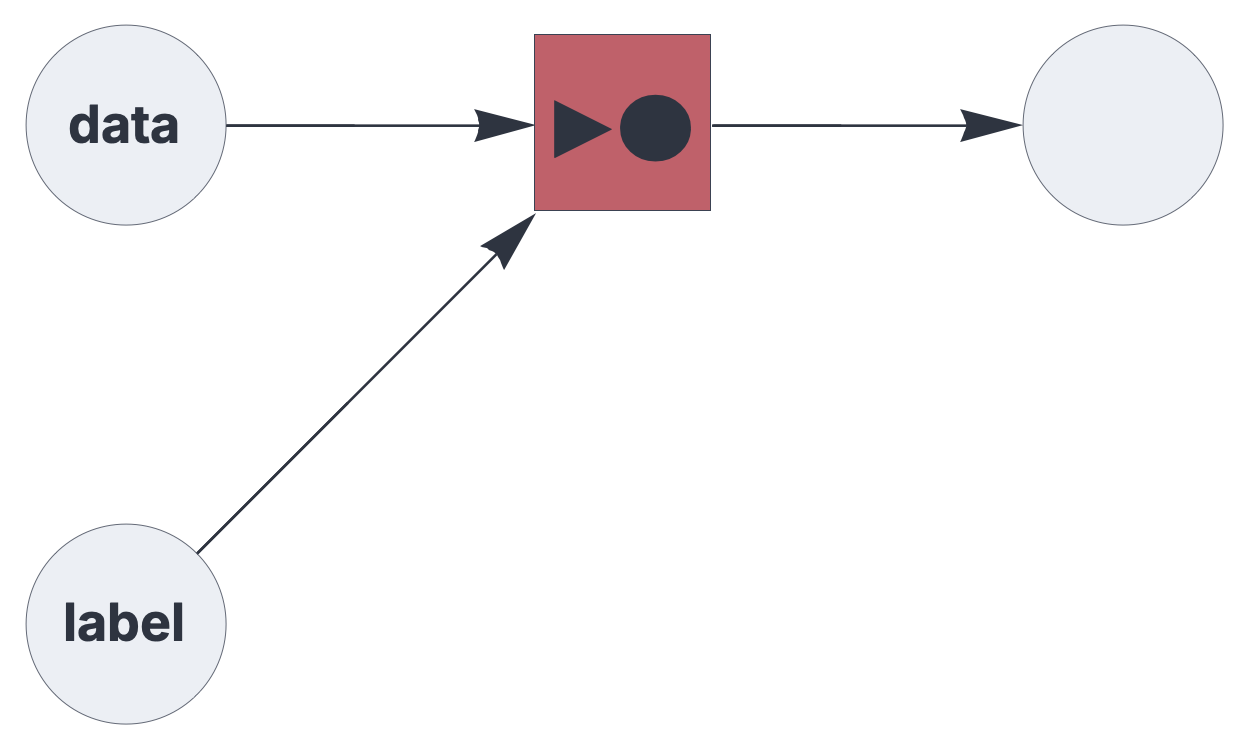
A basic supervised learning setup using hetero-associative memory:
{ "hyperparameters": {"default": [1000, 10]},
  "dataflow": [
    {"component": "input", "send": [1], "label": "label"},
    {"component": "input", "send": [2], "label": "data"},
    {"component": "associator", "send": [11], "receive": [1, 2]},
    {"component": "output", "receive": [11]}
  ]}
State transition memory
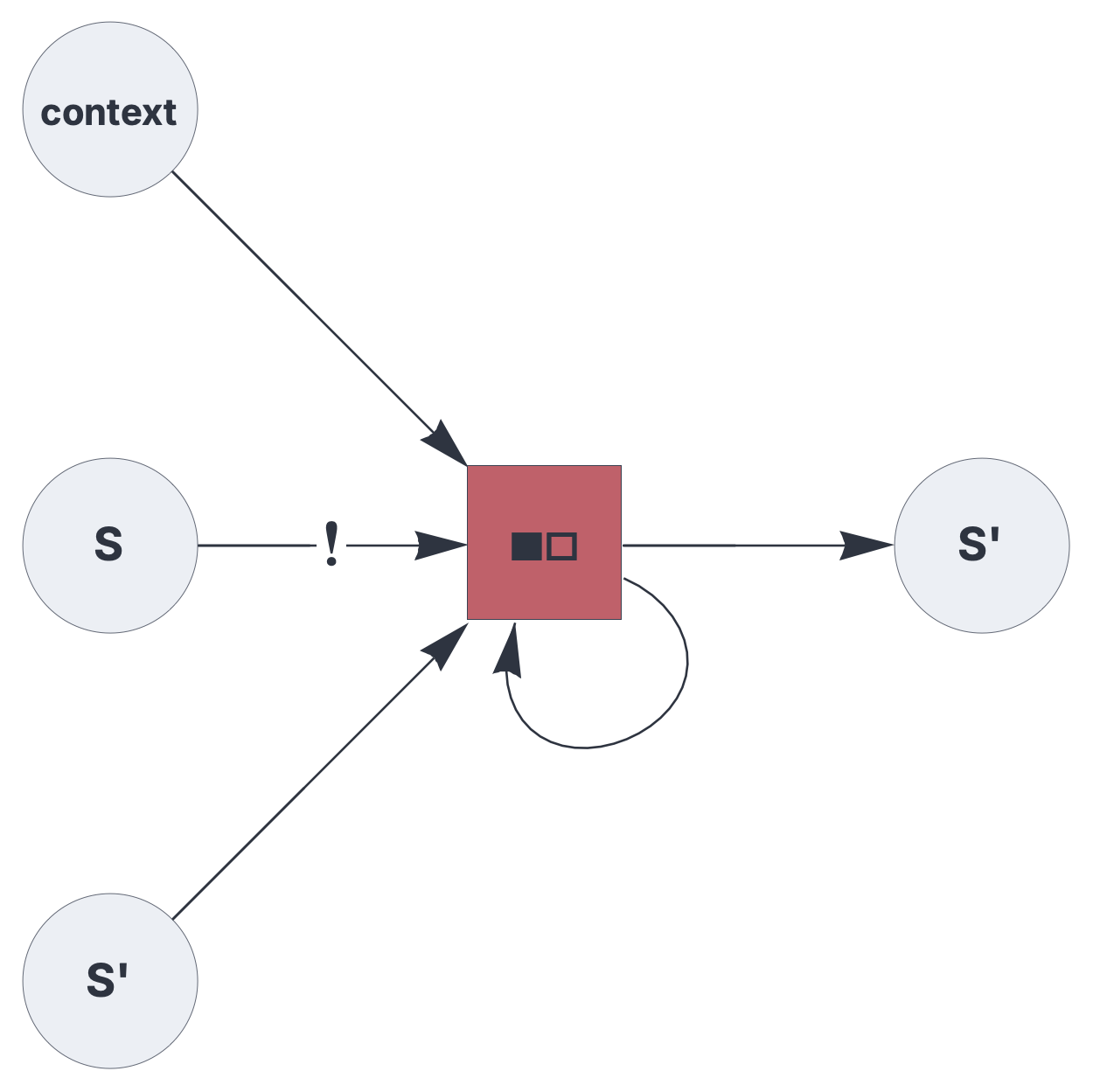
The following circuit implements a state transition memory that stores {S,context} -> S’. The feedback loop enables generative operation.
{
  "$schema": "https://creatingintelligence.org/schemas/circuit-v1.json",
  "hyperparameters": {"default": [2000, 10]},
  "dataflow": [
    {"component": "input", "send": [1], "label": "S'"},
    {"component": "input", "send": [2], "label": "S"},
    {"component": "input", "send": [3], "label": "context", "size": 8},
    {"component": "associator", "send": [11],
        "receive": [1, [{"slot": 2, "tags": ["priority"]}, 11], 3],
        "threshold": 0.7},
    {"component": "output", "receive": [11], "label": "S'"}
  ]
}
Source code
def associator(config):
    """
    Generic hetero-associative component.

    Stores heteroassociations A -> B.
    A can be block-coded.

    receive: B, A1, A2, ...
    send:    B

    If B and A1 are in the same dimensional space, this component
    represents a state transition memory:

    receive: S', S, C1,...
    send:    S'
    """
    receive_blocks = config.get("receive_blocks", [])
    Adims = [b[0] for b in receive_blocks[1:]]

    params_A = [sum(b[0] for b in receive_blocks[1:]), sum(b[1]
                    for b in receive_blocks[1:])]
    params_B = receive_blocks[0]

    Apop = params_A[1]

    # Limit size of query pattern. Applies to both storage and retrieval.
    # Default: unlimited.
    absratelimit = round(
        Apop * config.get("rate_limit", sum(Adims) / Apop))

    # Proportional stochastic subsampling, applied to the query only.
    decimation = config.get("decimate", 1.0)

    m_config = dict(config)
    m_config.update({
        "A_parameters": params_A,
        "B_parameters": params_B
    })

    M = Memory(m_config)

    # Special label for state transition memory
    label = ""
    if len(Adims) > 0 and \
            list(receive_blocks[0]) == list(receive_blocks[1]):
        label = "■" + "□" * (len(Adims) - 1)

    def f(B, *blocks):
        # Apply and drop inhibitory elements.
        X = resolve_block_join_normal(list(blocks), Adims)
        Y = resolve_normal(B)

        # Limit the rate of incoming positives.
        if len(X) > absratelimit:
            X = sorted(
                rng.choice(
                    X,
                    size=absratelimit,
                    replace=False).tolist())

        # Always learn (does nothing if B is empty)
        M["store"](X, Y)

        # Proportional stochastic decimation of query pattern.
        Xdec = X
        if decimation < 1.0:
            sample_size = math.floor(decimation * len(X))
            Xdec = sorted(
                rng.choice(
                    X,
                    size=sample_size,
                    replace=False).tolist())
        if len(Xdec) < Apop:
            Xdec = X

        return (M["retrieve"](Xdec),)

    result = {
        "function": f,
        "checks": ["dimfirst", "multinp", "oneout"],
        "label": label, "size": 10,
        "shape": "square", "fill": 11
    }
    result.update(M)
    return result