ENCODERS & DECODERS
codec
General-purpose encoder/decoder for symbolic tokens.
See also: https://creatingintelligence.org/#sparse-holographic-representations
Details
- Dynamically creates a lexicon that maps tokens to Sparse Holographic Representations (SHRs).
- Encoder plugin for the
inputcomponent. - Decoder plugin for the
outputcomponent. - Encodes string tokens as well as general data structures.
- Creates a random SHR for each unique token.
- Decoding is based on the auto-associative pattern matching threshold.
- Maintains a globally shared lexicon for each hyperparameter combination [N, P].
Use standard style options to customize the plugin’s appearance in circuit schematics.
Encoding and decoding chain for symbolic tokens
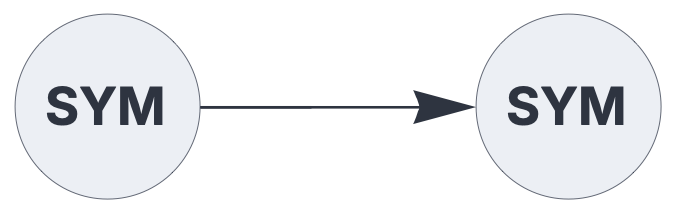
The following circuit encodes a token to an SHR and subsequently decodes it, mirroring the input.
{ "hyperparameters": {"default": [1000, 10]},
  "dataflow": [
    {"component": "input", "plugin": "codec", "send": [1]},
    {"component": "output", "plugin": "codec", "receive": [1]}
  ]}
Source code
def codec(config):
    """General-purpose SHR encoder/decoder for symbolic expressions."""

    # Extract hyperparameters from config
    hyperparameters = config.get("hyperparameters", [0, 0])
    n, p = hyperparameters[0], hyperparameters[1]
    lex_key = (n, p)

    # Initialize global hash table if missing for these dimensions
    if lex_key not in circuit_codec_lexicon:
        circuit_codec_lexicon[lex_key] = {None: []}

    lex = circuit_codec_lexicon[lex_key]

    # Use auto-associative pattern matching threshold
    T = matching_threshold((n, p), (n, p))

    def f(expr):
        # Encoding logic
        if config.get("component") == "input":
            if isinstance(expr, list):
                # Bundle multiple tokens
                bundled = []
                for e in expr:
                    res = f(e)
                    if res:
                        bundled.extend(res)
                return sorted(list(set(bundled)))

            if expr not in lex:
                # 1-based indexing for native arrays
                sampled = rng.choice(range(1, n + 1), size=p, replace=False)
                lex[expr] = sorted(sampled.tolist())

            return lex[expr]

        # Decoding logic
        if not expr:
            return None

        overlaps = {k: len(set(v).intersection(expr))
                    for k, v in lex.items() if k is not None}

        result = [k for k, overlap in overlaps.items() if overlap >= T]

        if len(result) == 0:
            return None
        elif len(result) == 1:
            return result[0]
        else:
            return sorted(result)

    def clear():
        lex.clear()
        lex[None] = []

    return {
        "label": "SYM",
        "function": f,
        "clear": clear
    }